Mindfulness on a Modern Camino

As I left Santiago and headed down the Camino Frances, I thought of the struggles I might face on the way. Walking backwards might not only pose a bit of a navigation problem, but as a fairly introverted person I feared it might get rather isolated with no way to make a Camino family. Turns out neither of those worries would be a problem because a) turns out tracking 1000’s of people is really easy, and b) it was really easy to struck up conversations with people knowing I would never see them again. What I wasn’t prepared for was the sheer number of pilgrims on the trail and the logistical problems that resulted. Even at it’s busiest after crossing the Portugal/Spain border, the number of pilgrims on the Camino Portuguese paled in comparison to what I would face on the Camino Frances, and as I headed against the crowds, the number of pilgrims seemed to multiply by the day as I was headed straight into one of the busiest months on the Camino, not to mention by year end 2016 would mark the most pilgrims on the Camino in recorded history (~278 000). The official number of pilgrims that arrived to Santiago via the Camino Frances the month I was walking was 21, 309, meaning that on average I was crossing paths with 710 pilgrims per day!

The number of pilgrims walking the trail had doubled in a short seven years, and as I began the Camino Frances I quickly learned that the number of albergues and beds were hard pressed to keep up with the hundreds of pilgrims on the Camino per day. This shortage (or perceived threat of shortage) created a rat race culture on the Camino; pilgrims would wake up at ungodly hours in the morning and rush to the next albergue to ensure they got a good bed, and after 3PM I was lucky if I was to come across a pilgrim on the trail. While the Camino Portuguese had more of a laid back atmosphere, we rarely booked beds in advance, were in bed by 10PM, or out of bed by 8AM, the Camino Frances had a somewhat militant structure. The accommodation created a culture on the Camino Frances that to me, was all to similar to the culture than many pilgrims were trying to and needed to get away from in their daily lives. At home, many have a fairly strict schedule leaving little room for the unknown, and on the Camino with morning wake up, departure, and arrival times strictly planned out, many pilgrims were allowed to continue on with their habitual routines, allowing the Camino to pass under their feet in a haze.

My first stay in an albergue on the Camino Frances, I would be irritatingly woken up at 4:30 AM by the “bag rustlers” shining their lights and packing up to head out for the day, falling back asleep I would be rudely awoken at 7:30AM by the receptionist and informed that all pilgrims must be out of the albergue by 8 AM! This I had most definitely not signed up for. I am not a morning person so I was pretty peeved to learn that on my vacation I would have start setting an alarm. As I made no move to get out of bed calculating I could sleep for another 20 minutes and make it out by 8, the clearly thought otherwise as she looked dubiously at my belongings that were strewn on top of my bag. What she didn’t know that my bag was similar to a children’s puzzle, and while it may look like it would take a bit of time to put together to someone who hadn’t seen the picture on the puzzle box,  I could put my bag together in about 5 minutes.

The number of pilgrims on the Camino France route and resultant culture was so overwhelming, that after a few days on the trail some pilgrims would hop a bus and start down a different route to Santiago such as the Camino del Norte or the Via de la Plata. If you’re looking for a quiet enjoyable hike that may be a fine thing to do, but if you are doing a pilgrimage it is important to trust that everything on the Camino is exactly as it should be for your journey. For myself although there would be some growing pains and grumpy early mornings as I got used to the Camino Frances, I knew that if I was mindful enough there were lessons one could learn that could only be taught through crossing paths with 100’s of pilgrims everyday on the path. As I worked to change my perspective of the number of pilgrims on the Camino from negative to positive, I realized that the growing number of pilgrims in recent years was a reflection of our modern lives. With internet we find ourselves interconnected with more and more people than ever before, with social media we may interact with 100’s or 1000’s of people a day when pre-internet we would be lucky to talk to 20 people a day. It was only fitting that the Camino had changed over the years to mirror this. Much like the Camino, in our lives we can choose to distance ourselves from others and try to hack it on our own, or we can use the increased interconnectedness to our advantage.

On the Camino Portuguese I had learned not to rush from point A to point B, and the Camino Frances tested this as I tried not to worry about arriving to albergues early enough to ensure a bed. It was a practice in releasing control and having faith that everything would work out, something easier said than done. Luckily, I had brought an air mattress, so I knew if worst came to worst I could sleep on a floor or outside, and with this backup I was able to step away from the bed races and hike the Camino on my time. As it would turn out, despite some late arrivals after 6PM, I always managed to find a bed! I would end up using my air mattress to camp out some nights, but that was a result of deciding I would camp when I set out that day, not due being turned away at albergues. It was amazing how having a little faith could reduce so much of the stress and worry that many pilgrims had on the trail. Once I stepped out of the Camino rat race, I had very little worries and my Camino experience would transform for the better in other ways as well.

While many pilgrims on the trail could be heard complaining about the sheer mass of people on a narrow trail (especially after Sarria, the 200 km point and last place to start the Camino to receive a compastella). As I was hiking in the reverse direction, if anyone was going to have a right to have an annoyance at the number of pilgrims on the trail it would be me but I was having a completely different experience! Though I had to leave most albergues by 8AM, I would usually only hike to the nearest cafe to get a tea, only really starting on the Camino by 9AM and being out of the bed races meant I could hike well into the afternoon, often stopping between 5 and 6PM. While I would pass many pilgrims in the morning, often getting weary of the pilgrim’s greeting on the trail when passing of “Buen Camino” as going in reverse I passed every single pilgrim, after 12PM pilgrims on the trail tapered off significantly. By 2PM I often found myself hiking in solitude for hours, enjoying the mild May temperatures and beautiful scenery in complete silence. One didn’t need to uproot and head to Santiago on a completely different route to find solitude, all one really needed to do was change their approach and one could find all the solitude in the world on the Camino Frances.

Potential pilgrims often find themselves turned off of doing the Camino Frances route because of the numbers and stories that circulate the internet. For myself, the Camino Frances was exactly as it needed to be for me to learn what I was supposed to learn on it. It is challenging to maintain mindfulness on the modern Camino Frances, more so than quieter routes such as the Camino Portuguese, but not in a bad way.  If one can learn to maintain mindfulness on the Camino Frances, they will be better prepared to maintain that mindfulness as they return to the hustle and bustle of their homes. For some it may be too overwhelming to start on the Camino Frances and like myself it may be better to start on a quieter route before heading down the Camino Frances, but I strongly recommend not to completely discount it based on the number of pilgrims walking it. Even if it is not clearly describable why, there is a reason it was in medieval times and still is the most traveled pilgrimage route and the Camino Frances will always be a special experience whether there are 1, 1000, or 100 000 pilgrims on the way.

Back to Camino de Santiago blogs

It’s Not the Destination

Although Santiago was never my end point, as I neared Santiago I started to think about what might await me at my destination, that something might await me at my destination. Millions of pilgrims had traveled for 100’s of miles for 100’s of years to Santiago, there must be something spectacular at the end that people continue to make the journey. I knew inherently, that anything I expected to happen would not happen. Traveling to new places taught me that very quickly, things would never turn out as I expected them to. Sometimes for the good, sometimes for the bad. Regardless that didn’t stop me from thinking about what might happen when I got there. While many Pilgrims that I talked to who had already made the journey once said that it was often a let down (if I had actually bothered to finish watching the movie “The Way” I would know that), still there was the odd story of pilgrims who upon arrival burst into uncontrollable tears, experienced bliss beyond their wildest dreams, or had a spiritual awakening. I thought since I had done all this spiritual work in Peru and India beforehand, I would be a shoe-in if any pilgrim was to be chosen to have a strong experience upon viewing the Cathedral. I was very wrong.

My arrival into Santiago was about as anticlimactic as it could be. The last 20 km started on enjoyable natural pathways, but as with all urban centers on the Camino, the path quickly turned to asphalt and trudging along the shoulders of busy roadways. There was very much an upside though, the path into Santiago was on an enjoyable gentle down-slope, with one final uphill push as you neared the cathedral. The day was grey and dreary, and as was within a few km of my final destination for the day, it started to rain! I can’r remember if it was just plain hardheadedness or for some unknown spiritual reason, but instead of stopping to take my raincoat out my bag I plodded on unimpeded, rain slowly soaking through my cotton sweatshirt. Needless to day, I arrived at the cathedral cold and sopping wet. To add even more to the anticlimacticism, upon my arrival at the cathedral I was quickly turned away at the door, no one was allowed inside with a bag. Maybe a way to avert terrorism or theft, but I think it had more to do with getting pilgrims to go to their hostel and and showered before showing up. As a pilgrim we had all grown accustomed to the musty smell of sweat and body odor that took on not only us but our bags as well, deodorant long ago used up or abandoned in hopes of reducing weight, and though we no longer recognized it, the smell was often found offensive by the general public.

 It would turn out that the most climatic event of my arrival into Santiago would be my accommodation for the three nights I would be there. Tipped off by a fellow pilgrim along the way I had called and booked a room at the San Marinto, a beautiful monastery converted into a hotel adjacent to the Cathedral. With regular rooms ran upwards of 100 Euro, I learned one could book a special “pilgrim room” which for 30 euro included a buffet breakfast, a private room, and one’s own shower! Though the room was small and basic compared to the ones I had seen on the website, it did little to ebb the ecstatic feeling of finally being in a private room! It was the first time I had been in a private room since India, and the first thing I did was there my bag on the chair, stripped down and just lied in bed. Seeing the Cathedral could wait, as for someone who regularly sleeps sans pyjamas, being able to strip down after weeks of sleeping in the confinement of clothes was nearly enough to bring me to the tears of happiness that pilgrims of legend had upon entering the cathedral.

The next day after gorging on the buffet breakfast and obtaining my pilgrim credential (I would somehow be blessed with only three people ahead of me in line at 9Am, other days at this time the line would extend out the building and require a wait of hours) I saw a sign in English for a meeting called “Camino Companions,” a time to reflect with other pilgrims about the journey. Eager to discuss with others their thoughts upon completion of the pilgrimage (and the sign promised free tea and cookies!) , I attended the meeting that afternoon. Run by a order of Irish nuns, we were given a few questions about our pilgrimage to reflect on and then discuss as a group including why we had walked the Camino, what was the most difficult part, and what was a significant moment. It had been easy in the excitement of reaching Santiago, and the subsequent disappointment upon arrival to forget everything I had learned in the four weeks it took me to reach there. Sitting down and reflecting with the Camino Companions and fellow pilgrims reminded me how much I had learned along the trail.

In the four short weeks it had taken me to reach Santiago from Lisbon, I had increased my present moment awareness tenfold, more so than mediation in India and ayahuasca in Peru had. I had begun to observe how what I surround myself with affects my thoughts, and how my thoughts affect me physically, while also making lifelong friends along the way! I realized that the actual city and Cathedral of Santiago had very little to do ones spiritual grown on the Camino. Other than providing a direction to walk, a place to stop (or one might cont me walking forever), and the opportunity to receive a piece of paper stating how far one walked to show their friends, reaching Santiago was not the point of the Camino. Though the remains of Saint James could be viewed there, kneeling down before them did not bring one any closer to him even if they had walked 10, 500, or 2000 km to get there. Saint James was present during every step on the Camino, if one took the time to look.

I still couldn’t shake the idea that something miraculous should happen in Santiago, and on my final day I found myself wandering around the city aimlessly, trying to let my feet guide me to something I might have missed. I wandered in and out of the many old churches throughout the city, appreciating the 500+ year old architecture at a level only someone who grew up in an area where the oldest building was only around 100 years old could. As I strolled through an open garden I found myself looking to the hills of Galicia on the horizon, and in my heart grew that familiar feeling, the itch to be back on the trail. I didn’t know what I was looking to find or where I would find it, but I knew it would not be found within the stone walls of Santiago. The Camino beckoned me onward, I still had almost 800 km before I would cross the Pyrenees and reach my end point at St Jean Pied de Port in France. Though it’s not the destination but the journey that would be the truly exciting part.

Back to Camino de Santiago blogs.

Fear and the Solo Female Traveler

Oh you’re planning a trip? Who are you going with?? Are you meeting someone?

These are the common questions I was faced with when I told anyone about my plans to travel around the world. To some it was unfathomable that traveling to remote corners of the world was something that could be done alone even as a women, and going alone was something I actually wanted to do. It seemed like they would rather get a root canal than venture out into the great unknown without some form of companionship. When they finally did believe that my plans were serious, there was a common opinion of me; “You must be really brave.”

Me. Brave? I don’t think so. I had been traveling solo to Peru and Ecuador for the past four years, and never once thought of myself as brave. Stupid, yes, often. But brave, never. There seems to be this stigma held that traveling is this big scary thing, and when you’re traveling without planned tour, not in a resort, and on your own, especially as a women, you must be narrowly avoiding rape and near death at every corner. Traveling solo as a women is painted as this big scary thing, I can’t put a number to the amount of blogs written on the subject, telling one what to do, what not to do, advice making one afraid to leave their trip-advisor approved hostel, turning traveling into a chore rather than fun.

The majority of the people you will meet anywhere in the world are just REGULAR people, though cultural norms and certain idiosyncrasies may be very different than home, at the heart the majority of people will be governed by the same moral compass. What does this mean for a young solo female traveler? Don’t do anything you wouldn’t do at home and trust your instincts if you are. Many of the horror stories one hears about solo travelers arise when people see travel as an opportunity  to let out their inner wild child with people they will never see again. An important part of traveling is the opportunities that push you out of your comfort zone, but there is a striking difference between bungee jumping or hitch hiking with friendly locals and taking drugs at a club or going somewhere with someone because they pressured you (prepare yourself to be assertive in saying no to men’s advances, being a tourist you will experience an aggressive level of pressure from locals not only in markets, but all the way to romantic offerings as well).

I only started travelling when I was 23, so maybe I never put off the same vibe to attract the same frequency of negative situations as a more naive 18 year old might, or maybe more stories sell when they focus and elaborate on the negative side of situations, but on my travels, the majority of the time I felt safe. I wandered cities at night, took local buses, hitchhiked, drank the water, drank some alcoholic beverages, and talked to people (including men) that I met. All alone. I never felt I was in any danger, though not all my encounters with the opposite sex on my travels were positive.

On a trip to Ecuador, I had a rather uncomfortable run in with a local male. While wandering the beach in broad daylight I became aware of a young local following me. I had wandered off the main beach onto a rocky outcropping, though two other tourists were visible a few hundred meters ahead. I continued on though not completely comfortable with the man now following me, and just to be safe I picked up a “walking stick” off the trail. As I wandered among the tide pools attempting to catch some of the little crabs, the local started to try to engage in conversation with me. The polite Canadian in me could not just tell him to go away, as he started speaking to me in Spanish I figured he would soon clue in to my terrible understanding of Spanish and give up.

He was not to be deterred that easy though, and with broken English he pushed on, inviting me to dinner at his house that night. Unable to shake my polite Canadian demeanor and just tell him to %$&* off, I had to get creative in my evasion tactics. Drawing on my grade 7 curriculum of a semester of mandatory french class, I decided that posing as a French Canadian was a viable option, “Solo hablo Frances” I responded to his invite shrugging my shoulders with a blank look (I should mention I would have failed French class had I not seen the final exam the day before I had to write it). Thinking I was finally in the clear I started to walk away, he called me back and I turned around to see him holding out a crab he had caught. I couldn’t deny my inner 5 year old that was desperate to catch one, so I walked over and took it from him.

As I looked up from the crab I had so desperately wanted to catch, I was shocked to find that the local had pulled down his pants and was giving me a full view! I quickly dropped the crab and while grasping my multi-functional walking stick said “umm no thanks!” while turning and walking quickly away towards the other tourists. He seemed to finally get the hint and did not attempt to pursue me. I was in a very touristy area known for partying, drugs and alcohol, so as much as I couldn’t fathom this approach to women ever working, I knew it must have worked once down the line for it to become something attempted in broad daylight.  I had wanted to catch some crabs on my walk, but not the type of crabs he was offering!

While some of the men I had met in South America seemed very forward, they had nothing on how men treated solo females in India. Many young men I crossed paths with seemed to think that foreign females travelling on their own must be desperate for male companionship, despite them vocalizing the opposite. Whether walking down the street, sitting at a cafe, or riding on a train; doing anything without a males companionship was the equivalent of wearing a big red sign saying “single and ready to mingle.” It was not uncommon to be approached by a local and interrogated about ones marital status. I learned to never, ever say that I was single. Though claiming a boyfriend or even wearing pretend wedding ring did very little to deter their pursuits, often claiming that when one is on holiday those commitments are as well.

I was surprised at the aggression that could result if I tried to politely dismiss their advances like I would do at home and had done in South American countries. One evening I ended up being invited to an Indian wedding by a tour operator. I was told that other tourists would be coming, and having heard that Indian weddings are not to be missed I accepted the invite. As soon as I arrived I felt the urge to leave, it was not the spectacle I had been led to believe, as soon as I arrived the tour guide ushered me into a small room where illicit alcohol was being served. Only one fellow tourist had managed to make the wedding, and feeling rather out of place I took a seat beside him and made conversation.

Not long after, and a few shots of whiskey later, the tour guide who had brought me pulled me away from the other tourist. He told me that he was offended that I would be talking to another man when he had brought me as his guest. Feeling really uncomfortable and knowing this night was on a crash course for a finale I did not care to be a part of, I demanded that I drive myself back to my guesthouse immediately. A younger me would have stayed to avoid hurting someone’s feelings, part of me believing that the tour guide had honorable intentions, but the few years of traveling I had under my belt had wizened me to nip these situations in the bud. In India especially, anything that was not a clear and aggressive “no” was interpreted that there was still an opportunity to pursue.

A few weeks later at the guesthouse I was staying at, over the course of a few days the cook had gotten progressively aggressive to another female tourist, not taking no for an answer. Finally, one morning things escalated after he had tried to lure her into his room, matters were dealt with in a rather western justice manner, a couple men showing up and “discussed” the matter with the cook in his room. Some time later, the cook emerged stiffly from the room sporting a freshly forming black eye, and was fired on the spot with his wages for the month given to the girl. Though I had been experiencing some of the Indian male forwardness, it was the first time I had witnessed it escalating to that level. Within the context of the spiritual hub of Rishikesh, it was a shock to the system to witness how the situation was handled, and a part of me sympathized with the cook.

For any female considering travelling solo to any country (especially India), be forewarned that it will be a challenging experience, but don’t let that deter you. Travelling solo will be the most rewarding thing you ever do, and something that is only possible at certain points in your life (I am told that the average person will spend a very little proportion of their life single (slightly hard to believe as a perpetually single person, who’s longest relationship lasted 3 month, with two of those months spend building up the courage to break it off), then factor in kids, and solo time will be a thing of the past!). Unless you have never lived outside of your parents basement, you will have the skills and instincts to travel solo without mishap, while wandering more than a block from the hostel, going out at night, and riding local transit despite what online articles and blogs may say. Just be prepared for local women looking at you like you have a terminal illness upon learning you are not married!

What I Learned

When I decided to make India a stop on my tour this year, it was to try to find out why Steve Jobs and other famous people like the Beetles attributed their time in India so much to their successes. On the day I was flying out to India, I was discussing with my friend who was giving me a ride to the airport why I chose India. They asked me, if Steve Jobs was so successful and spiritually in-tune, why did so many people not like working with him?  At the time I didn’t have a good answer, but the question stuck in my head. Was it that Steve Jobs didn’t find his success by following his interests and passions, but by using and abusing people like many CEOs of large corporations? I based my trip to India on the fact that Jobs had said it was influential for his career and I was desperately seeking some type of insight into my career path, but was I idolizing the wrong person? Through my time in India, I found an answer to my friends question of the validity of Steve Jobs’ success, an answer which would also prove insightful at a scale beyond just my career path.

First, what comes to mind when you think of someone who is successful? People’s answer to this question will vary slightly but most likely involve an aspect of 1.financial security and status 2. physical appearance and 3. having a spouse with the first trait (if you’re a woman) and the second trait (if you’re a man).  To be a success, one must be head of a multi-million dollar company, liked by all who meet them, have invitations to dinner with royalty, married to someone deemed physically attractive, and have 2.5 kids, all who are in the 95th percentile, and master’s at the cello and signed by a professional sports team at age 12. We rarely judge someones success based on their personal fulfillment, society will always see someone who lives in a log cabin without electricity as less successful as someone in a multi-million dollar house.

I spent a year living in the UK and couldn’t believe how much people were limiting themselves based on societal ideals (probably a problem in every first world area including my home, but easier to see as a foreigner coming in). From going to a proper pre-school to living in the right neighborhood to having a specific accent to looking to the royals for what to wear, lives were cookie cutter and full of how things needed to be done, leaving no room for people to follow their intuition and find true personal success outside the box. I found it interesting coming across an article studying graduates from Universities across the UK, how those who went to lower class Universities had more career and financial success than those at the prestigious ones. Why? Because the graduates from the lower class grew up with less of the pressure of the “proper” (and often expensive) way to approach life, and could think outside the box. More of these graduates started up their own businesses and took career risks, while the prestigious grads having had their life mapped out for them since birth didn’t have the same out of box thinking style required to be successful once out into the world. Having a strong ideal of what success looks like and how to achieve it ultimately inhibited ever being successful. Now what does any of this actually have to do with my time in India, spirituality, and Steve Jobs?

Lots. These ideals and mimicry of deemed successful attributes are not only limited to the un-spiritual western world, but very prevalent in the world of spirituality. In India this mimicry was often very visible, with physical appearance closely tied with spiritual practice. In the Hindu culture, the color saffron color represented purity and non-attachment and thus saffron colored robes were worn by many following the path of spirituality (or pretending to for begging reasons). I seemed to be the only one who found the irony of being attached to wearing a color to symbolize non-attachment completely comical. If one has reached the spiritual state of non-attachment to the material world, would what color they wear remotely concern them? There is also a strong stigma around a spiritual master and what they can and cannot do; they must be celibate, have no earthly desires, and can never make a mistake. We hold on to these almost impossible ideals of what is necessary to be spiritual, then find ourselves discouraged when we fail to meet them. We think we should see white light and auras, talk with other consciousnesses, and have no desires when we reach a spiritual state, and in our journey when we don’t experience these things we worry and think we are not on the right track.

These spiritual ideals are no different than the western ideals of success, and their impact on our lives and actions are one of the same (we just think we are better off than the guy taking a loan out to buy a fancy new car). The ideals lead us astray and away from our intuition. Spirituality has many different faces, and wearing a orange robe chanting mantras everyday will not make you more spiritual if the reason for the action is based in fear. Many people will feel stuck in their life and/or spiritual practice and think that is has nothing to do with their actions, that it is the universe playing some cruel joke or that they are just destined to lead an average life. Being stuck is actually a sign your making the wrong decisions, rather than your choices being based on your intuition and personal truth they are shrouded with what you think is needed. Its like solving a basic math problem, but instead of reading that its a + sign, you think its a – sign as someone told you their problem had been a +. Though you are trying to solve the problem, you are only getting further from the answer. The problem is not changing or getting harder with every attempt you make, you just keep repeating the same mistake and getting frustrated that you still haven’t gotten the right answer without ever properly reading the question.

So should we really be looking at Steve Job’s external life as a measure of his success? Is a spiritual master less of a master if he doesn’t walk around in an orange robe? What I realized what the most important was to look at how he lived life. He never set out with the intention to become a billionaire, and that is probably the biggest reason he did end up so financially successful. He didn’t build any of his products with the goal of making the most profit he could, he made the products as innovative as possible with a complete disregard for costs. He did the best he could in that moment without thinking of what future gains or falls it might bring (and yes, some of his choices ended up being poor, but instead of regretting them he saw them for the value they served for learning). As per being liked by his peers, from a psychological standpoint one of the first signs of success will be having people strongly dislike you. Dislike has nothing to do with the person you have that feeling towards, but stems from yourself. To have a strong dislike of a person is a reflection of yourself, that person is exhibiting a trait you hold yourself back from embracing. Many find themselves jealous of successful people following their dreams and passions as they are too afraid to follow their own.

What I learned is to let go of the idea of what success or spirituality looks like, to learn as much as I can at every opportunity without wondering when and how it might benefit me in the future. To make choices based on the best I can do at the present moment in time, not basing a choice for some possible outcome that may come as a result. How often we think in stories when making decisions in any aspect of our life; if I do this, then this will happen, then this will happen, then this, and then I will be happy. Lots of times this happens subconsciously if we haven’t put the self work in and started to understand the basis of why we do and think what we do. How often do things go to plan and we even get to that second story layer, the first then this will happen? Never. Life is unpredictable and changes rapidly. All we can do is make the best choice right now.

A Disclaimer

Before I introduce you to the concept of Amazonian shamans and my experiences with them, I want to get you thinking about modern day science in a somewhat critical light. We live in a day and age of science, with the vast technology at our disposal we can observe tiny elements like electrons and measure electromagnetic waves unseen to the naked eye.  From these observations we come up with theories for how the world works. These theories turn into laws using the scientific experimental method where if a theory, after extensive testing under a variety of conditions holds true becomes a law. We fail to realize that there may exist a situation in which the theory fails, but we don’t have the ability or knowledge to test the theory in that situation. Talk to a research quantum physics scientist and they will probably tell you that our current understanding of our world covers less than 1% of what is actually going on and our understanding is constantly changing. In 1900 the famous scientist Lord Kelvin stated “There is nothing new to be discovered in physics now.”  At the time, Einstein was 21 and a mere 5 years away from discovering the theory of relativity.

When we are shown something we don’t understand we used to call it magic or witchcraft, but these days we use the word illusion or a placebo effect.  We are afraid to admit that yes this is really happening but no, we can’t understand why it is happening with our current limited technology and scientific understanding. We tend to have an unwavering belief in things we are told to believe as true, which can shield our eyes from seeing all the signs that suggest there may be more to the story. Just under 300 years ago creationism was still believed by the majority of the population, god had made the world in 7 days as well as every species on it. When people would come across fossils, they believed that they were just rocks being formed into that shape by complete chance as sometimes these fossils would be in the shape of bones of species that had gone extinct. Now it is common knowledge (for the most part), that these rocks are actually fossils and they can be used to understand the evolution of species over time.  “A foolish faith in authority, is the worst enemy of truth” – Alberta Einstein

So before you discount anything you might read in my blog about the healing work these shamans do as hocus pocus or that it’s just a placebo effect, I want you to remember that there was a time not all that long ago when the majority of the population deemed that the scientists who claimed the earth was round and that it revolved around the sun to be practicing witchcraft.  If we truly lived in a time where our current knowledge allowed us to have a complete and in-depth understanding of the world, would Donald Trump really be a serious candidate to run a country?

Back to Peru or next blog post

It’s Never A Good Time

T-Minus 8 Days Until Departure

Just like when you are preparing for exams in school, there is a tipping point a few days or weeks before the exam (or maybe the morning of the exam) where you realize that it coming up fast. Really fast, and you are extremely unprepared… One week before the departure on a two month trip seems to be my tipping point.

Doubt

Like most people in the world, I tend to second guess myself. Well actually tend to might be putting it mildly… More like constantly, relentlessly, and incessantly. I’m not sure if this is the same for other people, but deciding to go and booking the flights was the easy part. Now with only two weeks to go, the realization of how long of time two months actually is and how short of time one week is really sets in! And with that comes the second guessing about this whole trip and the thoughts that I am making a huge mistake and my life will be ruined forever. OK, maybe that is a little over dramatic. But I do worry that I will not accomplish the things I am setting out to accomplish on this trip, and it will be one big waste of time.

Why Not To Go

A lot of reasons have gone through my head as to why I shouldn’t go. Being a junior at a large company getting work on projects can be competitive at times, and one thing I learned is to never say no to work (unless already preoccupied). Part of my reasoning for choosing to leave in May and June was the fact that this is usually a slow period at work, but still I have found myself having to turn down work. And of course some of the work I turned down had to be in areas where I am really hoping to gain experience.

In addition to missing out on work opportunities, I will also be missing out on my personal life at home. Last month my dad completed his final chemo treatment for his lymphoma. The treatments have gone really well and he is now on the road to recovery, yet I will be leaving before he is 100% better and part of me worries that something could happen while I am away. Also with the start of summer comes the start of the rodeo season. For most of my life I have competed in rodeo, and for the past eight years every summer I have competed in the Canadian Girls Rodeo Association. But this summer as I will be on a different continent for half of the rodeo season I will not be competing.

It’s Never Going to Be a Good Time To Do It

I can come up with numerous reasons as to why it is not a good time to go right now, what I listed above is only a small portion of what goes through my mind. But really there will always be reasons not to go, no matter what when you plan to do something that is a major change from your daily routine.I’m going to generalize a bit here as not everyone desires to travel to a foreign place, but each of us desires to do something.  It’s very easy to only think of the negative side of things, and end up getting so caught up in the negatives that you never end up doing what you wanted to do. The conclusion I have come to about my trip is that even with all the things that can go wrong, the possibility of the things that can go right mean I will not be happy until I have at least tried. Without great risk will never come great rewards. 

With that I will leave you with a couple quotes and a fun picture..

“The little ideas that tickle and nag and refuse to go away should never be ignored, for in them lie the seeds of destiny” – Movie “Babe”

“Once an idea has taken hold of the brain, it’s almost impossible to eradicate.” – Movie “Inception”

Ecuador and Peru 2013!

A Little Background

This May and June I will be traveling to Ecuador and Peru. For those who don’t know me I thought I would give a little bit of a background as to why I am returning to South America for a fourth time and what I will be doing (and no, I do not have a boyfriend down there!).

My First Time

After graduating in 2011 I was able to travel to Peru for two weeks, where I fell in love with South America. I had never really been outside my own little world of rodeoing and living on a farm. Most of my travels throughout my youth had been for rodeo, traveling to such exciting places as Farmington, NM and Fallon, NV. The first time I stepped foot in the ocean was when I was 20! On my trip to Peru we traveled to the Amazon for four days where I had a brief introduction to the culture and nature there. Upon leaving my gut told me that I had to return to spend more time immersed in the culture and the beauty of the amazon.

I’m Back! (x2)

Seven months later I was on a plane to Ecuador to spend time with a native Shuar family in the Ecuadorian Amazon. On this trip I learned a lot and experienced things that I never could have fathomed. I was able to immerse myself into the Shuar culture and participate in ceremonies that have been in their culture for thousands of years! My experiences in the amazon were some of the most challenging yet rewarding experiences I have had in my life.  Seven months after leaving I returned to Ecuador for another visit. And now almost nine months since my last trip I will be returning to Ecuador and finally returning to the place where my desire to travel and love of the amazon began, Peru.

And Back Again!

This time around I will be traveling for 2 months! I will be volunteering at a sustainable rural development program in Ecuador (http://www.progresoverde.org/) for three weeks, where I will get to put my soils background to good use and give back to a country that has given me so much. After that I will be traveling to Peru, stopping in Lima for a quick stint before continuing on to the city Iquitos located on the banks of the Amazon River (which is the largest city in the world that cannot be accessed by road!). I will be spending some time immersed in the Shipibo culture, and I really hope to have to opportunity to swim with the amazon river pink dolphins! I will be hopefully be finishing my trip by traveling to Lake Titicaca, Cusco, and finally machu picchu. Gotta do some of the touristy things right?

To Blog or Not To Blog… 

I’m hoping to keep a blog of my travels. On my past two trips I have taken a journal with good intentions to write in it, but the only things I have written down are directions to give to taxi drivers! Here is hoping that I might be more apt to write about my adventures when there is a chance someone might read it.

Sunrise

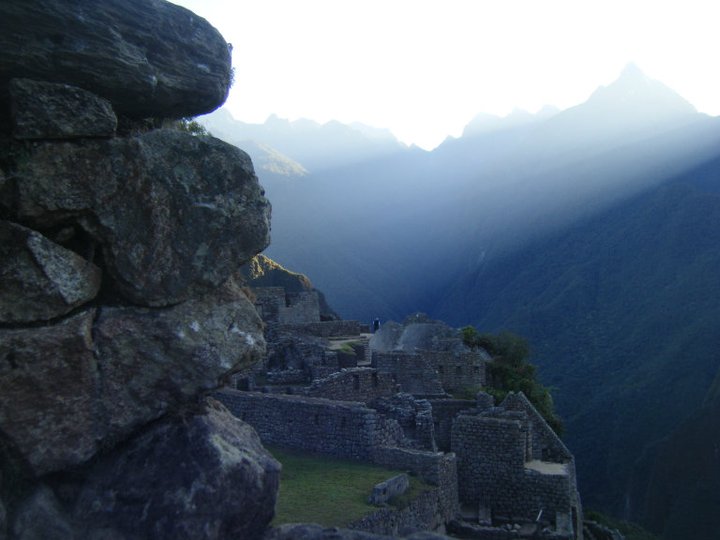
Sunrise at Machu Picchu